Sunday, June 29, 2008

HISTORY LESSON

Yesterday’s visit to the National WWII Museum was intense, poignant, and emotionally draining experience. As Ben, our tour guide, led us through the exhibits depicting the multiple stages of the last Great War, I was filled with a combination of extreme emotions. Although my great-grandfather died as a result of the war, I felt very little emotional attachment to the war. I knew the war’s historical significance, but I fondly thought of the war years as a romantic era involving epic love stories as depicted in multiple cinematic features, such as Pearl Harbor and Atonement. However, upon seeing images of dead and dying soldiers and hearing the audio commentaries of survivors, a wave of sadness and pride washed over me.

The image that most affected me was taken on June 6, 1944, or D-Day, and depicted the start of a month-long offensive known as the Invasion of Normandy. The invasion broke Hitler’s Atlantic Wall and marked a dramatic shift in the balance of power in Europe, tipping it in the Allied Forces’ favor.
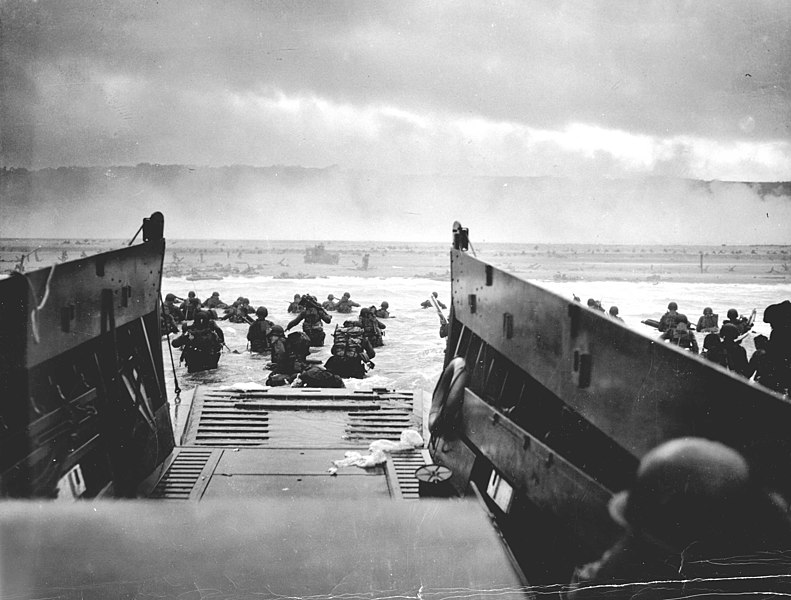
Even though the invasion represented a decisive military victory, it came at an incredibly high cost. Soldiers were ripped down before they could even advance a few feet into the water or fire a shot. Even those who were slightly wounded died by drowning as they were dragged down by their overloaded packs, which weighed upwards of 150 pounds. Boats were sunk, leaving survivors clinging to their sides, and those who managed to make to shore were cut down by enemy fire, leaving the waters and sands red.

I cannot imagine the chaos in the waters and on the beach. I cannot fathom the emotions the Allied soldiers must have felt as they ran off the Higgins boats in the first assault landing at Omaha Beach. They rushed up the beach into enemy fire, speeding into almost certain death with the knowledge that they may never be coming home. No matter who you are, their courage is undeniable. Regardless of whether their bravery was due to self-honor, dedication to country, or loyalty to their comrades, I am thankful for their sacrifices because I know that without them, I would not be who I am today. The concept "freedom" was redefined by their actions, something that affects every generation since that time.

Additionally, the museum also made me think about my passions and loyalties. I know that in previous posts, I had mentioned my renewed dedication to pursuing medicine, but the challenges faced in battling disease, though by no means trivial, seem unsubstantial when compared to those faced by the soldiers portrayed. Would I still feel the same commitment if I knew that following this dream could get me killed, maimed, or mentally damaged/scarred? Though I know that there are many brave soldiers fighting for "freedom" all over the world, I cannot see the same scale of national dedication as seen before. Whereas in the past, boys of 15 and 16 were lying about their ages to enlist, today most 15 or 16 year-old boys would rather concern themselves with Halo and Grand Theft Auto. Issues of national security are better answered with the use of bombs and missiles, which obviously reduce human casualties on our end. However, some of the gallantry of the past seems lost in today's automated world, and I cannot help but feel sad thinking about its loss.

Monday, June 23, 2008

MAKING A DREAM INTO A REALITY

Ever since I was seven years-old, all I have ever wanted to be was a doctor. Much like how some children hope to one day grow up to become lion tamers or astronauts, my dream was to save patients, cure illnesses, and ultimately, change lives. My desire to practice medicine was idealistic, unfettered by the realities of pain and hardship. However, after participating in a buddy program at Duke’s Children’s Hospital last summer, I saw an incredible disparity in quality of life and experience. Seeing a five year-old boy pulling a portable I.V. drip as he walked down the hall stood in stark contrast to my summer memories of playing with the neighborhood kids. My experiences in the hospital changed me and gave me a sense of purpose, thus solidifying my childhood whim into a concrete goal. Therefore, I insisted on finding an internship that would help me achieve my childhood dream.

My internship at Ochsner’s Hospital has given me an opportunity to see the practical application of medicine. The first of my clinical rotations started this past week, and despite the short time I’ve spent shadowing, each moment has reinforced my desire to become a doctor. Despite the hardships, ridiculous debt, and immense time commitment, medical school has never looked more appealing because I know that it’s the door to my future. I spent Wednesday with third-year Tulane medical students and sat in during their morbidity/mortality lecture conducted by Dr. Finger, a Duke alum. Conversations involved not only medical treatments and terminology, but also ethics concerning the responsibilities of a doctor, who bears the burden of blame if something bad were to occur, and the best way of helping patients whose conditions go from bad to worse. I am beginning to understand that practicing medicine is more than just a career; in order to become a successful doctor, one has to take on a new mindset, philosophy, and lifestyle.

It is odd for me to believe that I have finally found something that I can unequivocally say I can dedicate myself so completely and wholeheartedly. I tend to over-analyze every decision I make, wavering with indecision, sometimes unable to come to a conclusion or result that gives me 100% satisfaction. Whether it concerns buying a shirt at the mall or deciding what to do in a relationship, I have always felt a slight sense of fear that maybe I made the wrong choice. But with medicine, there is no hesitation or doubt, and the feeling of complete contentment gives me both hope and motivation that some day, my childhood dream will evolve into a grown-up reality.

Thursday, June 12, 2008

BE NICE OR LEAVE

The sign read “Be Nice or Leave,” in the lit display case of some miscellaneous store near Frenchmen Street. The message was strangely ironic to me since just moments before reading the sign, two individuals in the street had blown a trumpet in my ear and yelled out racially insensitive words in my direction, respectively. I was caught off guard. The incident reminded me of an unpleasant first day of high school after moving to Ohio, in which two boys yelled derogatory names at me due to my ethnicity. During the ride home, I thought deeply about the use of the word, “nice.” Could someone be nice all the time? Can being nice hurt you? What defines an act of kindness? However, even as I write this entry, the last question leaves me feeling puzzled.

For the past several months, I had been cramming for the MCAT, and for fear of failing miserably and not getting admitted to medical school, I opened up to the idea of applying for Teach For America, a program used to situate recent graduates from elite universities into failing education systems. The idea of helping a child receive a better education was thrilling; I thought, “I can make a difference,” just like in the movie Freedom Writers. So when I learned my DukeEngage internship involved tutoring students at New Orleans Science and Math Charter High School, I saw it as an early opportunity to make positive change. However, the reality of my situation was a handful of rising juniors who had trouble with basic elementary math. I met a 17 year-old girl who had trouble adding two 1-digit numbers without a calculator and a 16 year-old boy who could not correctly describe a square.

I want to help these kids succeed and break out of the abject cycle of poverty. I believe it to be ridiculous that students had been pushed so far through the education system without regard for their future well-being. I was taught to believe that everyone deserved an equal education, which was obviously not the case here. When low standards are set, it insinuates that one’s limit can only go so high, thus resulting in wasted potential. Sadly in New Orleans, the bar is nearly touching the floor; the parish constantly ranks near the bottom in a state education system that ranks near the bottom in the US. Instead of raising the bar, large portions of the math test allow for calculator use, which have led math teachers to turn from the fundamentals to tricks and programs in a TI scientific calculator.

However, the students’ lack of motivation also makes me feel like I cannot affect change so why try? For two days, I tried to earn the students’ respect. Yet, the boys just pointed and snickered whenever I tried to get them to stop talking, and the girls rolled their eyes when I showed them geometry problems and tried to secretly text each other. I have caught myself thinking, “It’s your loss. Good luck on your own.” So back to the question of “What defines an act of kindness,” I believe that my time spent at the school is known as nice and good, but if some of my thoughts are uncharitable and marred with frustration and antipathy, aren’t I actually being mean and, in which case, shouldn’t I leave?

Monday, June 9, 2008

JUST THE BEGINNING

I really have no idea how to start this blog entry because so much happened in the mere seven days since I arrived in the Crescent City. Finding a certain event to pinpoint and analyze just doesn’t do the experience of being in New Orleans justice. But if I had to choose one thing that unequivocally represents what the city has shown me is the resilience of the population. Not even one of the worst natural disasters in United States history could defeat the folks that I have met. They still dance and sing the jazz of years past as if nothing had ever changed. I remember something I wrote in my essay to get into the DukeEngage program.

What attracts me to NOLA are the multitude of cultural influences found in the food, the music, the art, and especially, the personality of its population. Although the population was greatly diminished after Hurricane Katrina, the people’s desire to rebuild and their hope in a better future speak volumes on the strength of the city’s spirit.

Three years later and after just one week embracing everything the city has to offer from dancing the night away with New Orleans natives at the New Orleans Museum of Art to tripping on the cobbled streets of Bourbon Street to preparing pralines with Anne at the Louisiana Culinary School, those two sentences epitomize my feelings about the people I’ve met. They are the type of people who see the glass as half full (with the possibility of the glass magically filling itself to the brim).